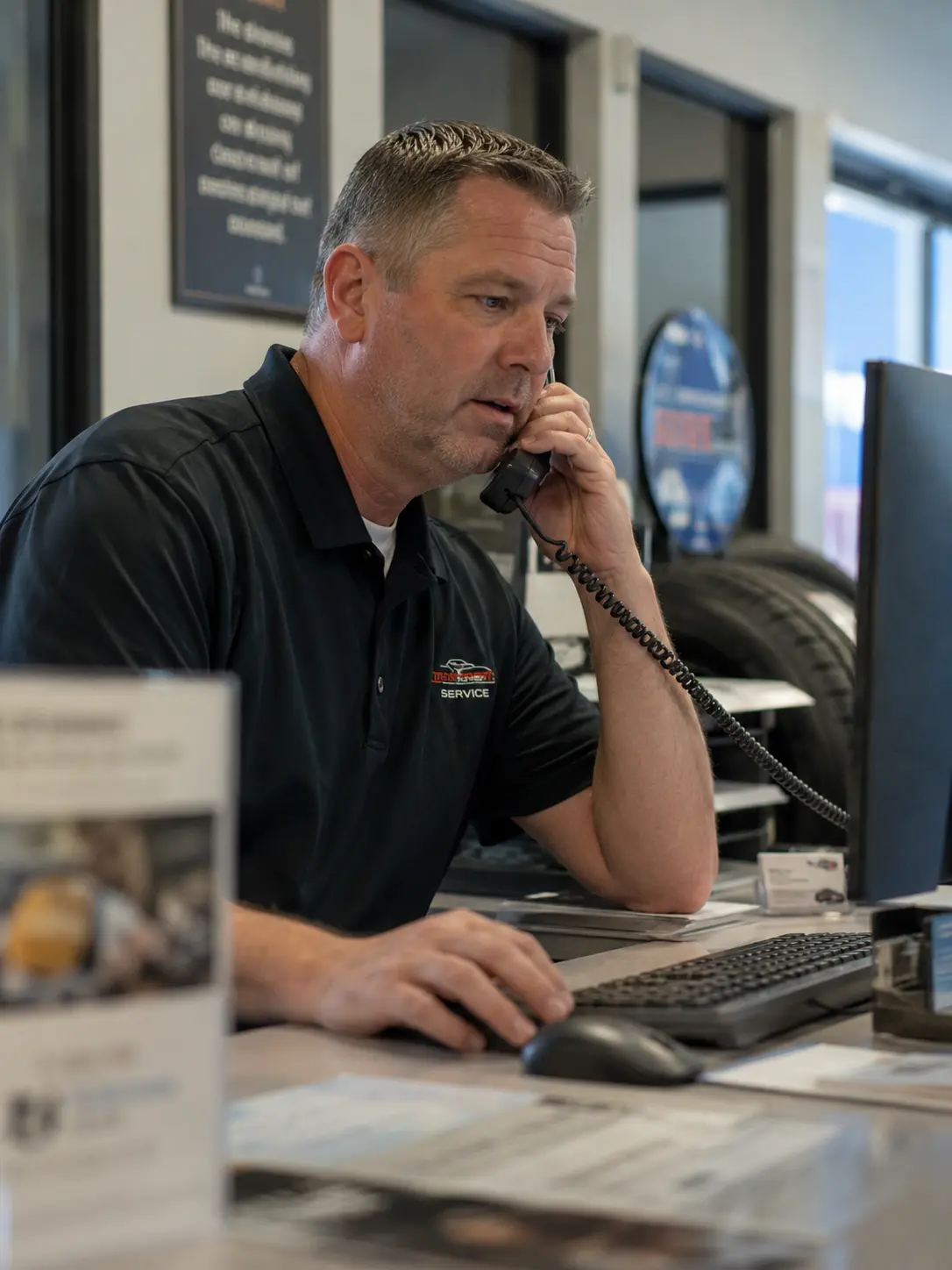
Ask a service manager how many calls the drive missed last month and most can produce a number, even a rough one. Ask a parts manager the same question about the counter phone and the answer is usually a shrug. Not because parts calls matter less. Because almost nobody is tracking them.
That gap is worth closing. Fixed operations, service and parts combined, accounts for 49.6 percent of the average franchised dealership's gross profit (NADA). Parts is not a side department riding on service's numbers. It is close to half the store's profit engine, and the counter phone is one of its primary intake points.
Why parts calls get less attention than service calls
Service call handling has a natural forcing function: a missed call usually means a missed appointment, and appointments show up on a schedule where a gap is visible. Parts calls do not work that way. A caller asking about a part number, a special order, or availability either gets an answer, gets a "let me check and call you back," or gets nothing, and none of those outcomes leaves a trace anywhere a manager is likely to look.
Most of a parts department's volume is generated by the service department itself, the parts that go on repair orders written by advisors and installed by technicians in-house. That internal, service-driven volume typically runs 70 to 80 percent of a parts department's business (WANADA). The remaining 20 to 30 percent, wholesale accounts and retail counter and phone sales, is smaller as a share, but it is also the part of the business that depends almost entirely on someone answering a ringing phone correctly. There is no repair order forcing that revenue to happen. If the call doesn't get handled, the sale usually doesn't either.
Retail phone orders skew toward the transactions a store can least afford to lose. A customer replacing a wiper blade will walk in. A customer who needs a specific ECM, ABS module, or a part they're not sure is even the right one for their vehicle will call first, because the ticket is too large and the risk of ordering wrong is too high to just show up and guess (Spork Marketing). Those are exactly the calls that need someone to look up a VIN, cross-reference a part number, and confirm fit before quoting a price, which takes longer than the ninety seconds a busy counter can usually spare.
Where the call actually gets lost
Parts counter staff are pulled in the same direction service advisors are, except the interruption comes from three sources instead of two: the customer standing at the counter, the technician handing over a ticket for a part needed mid-repair, and the phone that keeps ringing through both (Spork Marketing). Whoever is closest to the phone answers it, if anyone does, and the quality of that call depends entirely on whether that person happens to have the right lookup tool open and the counter customer's patience to spare.
The common failure pattern is not a dropped call. It's a "let me check on that and call you back" that never gets a callback, because the person who took the message is three interruptions removed from it by the time there's a free minute. The caller doesn't complain. They call a competing store, or a parts marketplace, and the dealership never finds out the order didn't come back.
What fixes it is a structured handoff, not more headcount
The parts calls that need a person are the ones requiring judgment: fit confirmation on an ambiguous part, a warranty question, a price negotiation on a wholesale account. Everything upstream of that, capturing the VIN or part number, the caller's contact information, and what they're actually asking for, is mechanical and doesn't need to happen in front of a customer at the counter.
Uobo-Connect's service call handling treats parts inquiries this way. It qualifies the call, captures the VIN and contact information, and routes the inquiry to the parts counter with a callback window attached, so the person following up works from a complete note instead of a scrawled name and a guess at what was asked. The counter staff still make every call on fit, pricing, and availability. What they stop doing is triaging the phone at the same time they're triaging the line in front of them.
What to check at your own store
A few questions worth asking before assuming the counter phone is handled:
- Does anyone know how many calls the parts line gets in a week, or does the number simply not exist?
- When a counter person says "let me call you back," is there a system tracking whether that callback happened?
- How often does a technician's parts request or a walk-in customer take priority over the phone, and what happens to the caller when it does?
If those answers are unclear, the leak isn't the call volume. It's that nobody built a way to see it.