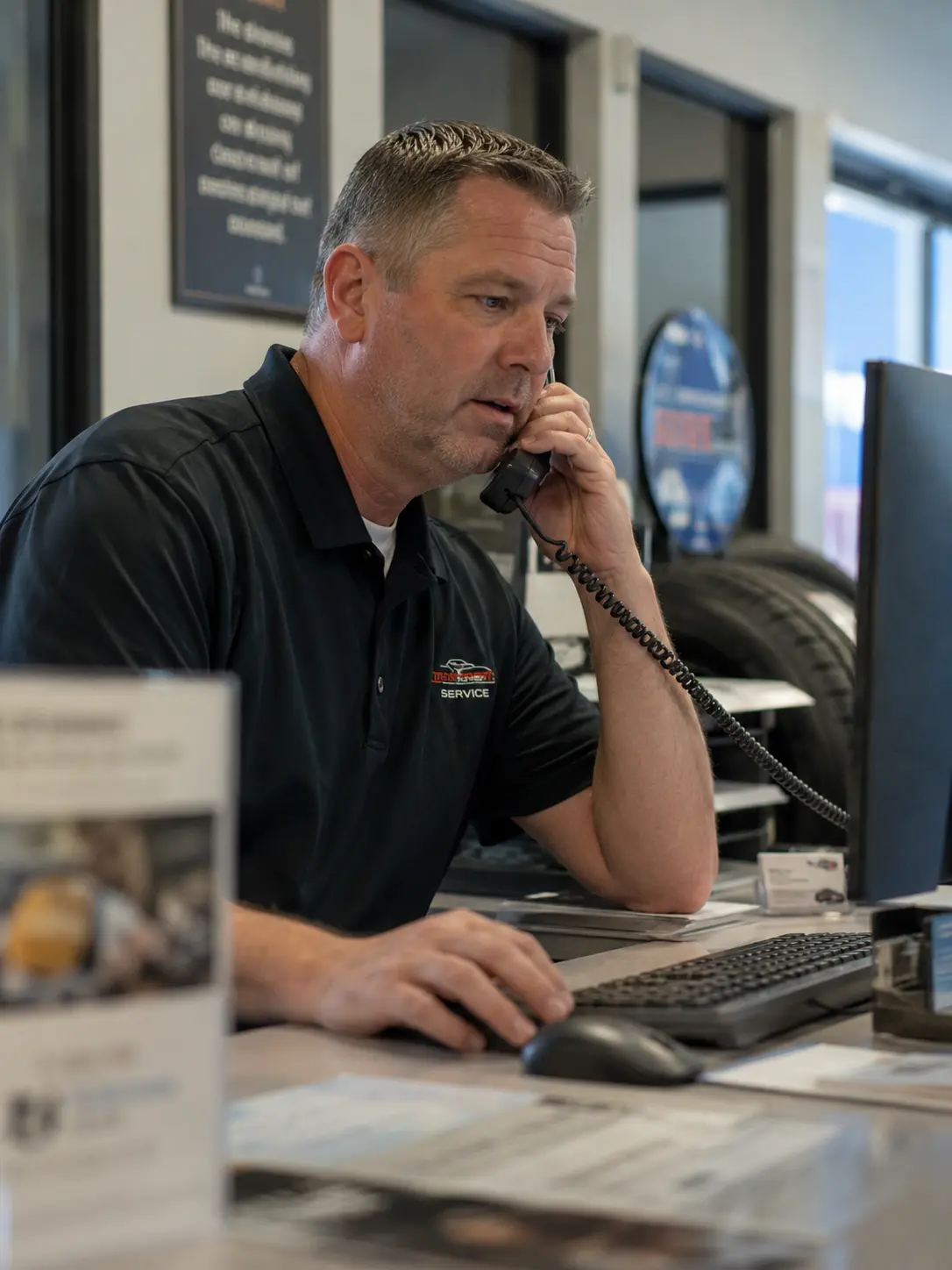
Most calls to a dealership service department are not requests to book. They are questions: when can you get me in, and what will it cost. The answer a caller hears to those two questions decides whether the repair order lands at the dealership or at the independent shop down the road.
What the service line is actually asked
Auto Dealer Today's fixed-ops column on incoming service calls breaks the volume down this way: for every five calls into a service department, one results in an appointment, three are asking about availability or price, and one is asking about the status of a vehicle already in the shop (Auto Dealer Today). The same column reports that 57 percent of service advisors do not ask the caller for an appointment.
Put those two figures together and the pattern is clear. The largest share of service calls arrives as a question, and more than half the time the person answering never turns the question into a booking. The caller hangs up with information, not a time slot.
Why these calls convert so rarely
An availability or price question is a comparison-shopping call. The caller is usually ringing more than one shop, and the first one that gives a clear, confident answer has the advantage. That puts pressure on exactly the moments when an advisor is least able to give one: standing at the desk with a customer, waiting on a technician, or already on another line.
The quality of the phone experience varies widely across the industry. In Pied Piper's 2025 Service Telephone Effectiveness Study, which placed scheduling calls to 1,739 dealerships owned by the 17 largest US dealer groups, only 13 percent of stores scored above 80 on a 100-point scale, while 20 percent scored below 40 (Auto Remarketing). Those are the largest, best-resourced groups in the country. A single-rooftop store with two advisors has less slack, not more.
What a consistent answer looks like
A caller asking about availability needs a real opening, stated plainly, with an offer to book it. A caller asking about price needs the question handled without a stall: what the service involves, whether a quote depends on the vehicle, and a next step that does not require calling back. None of this needs a senior advisor. It needs the same answer every time, at any hour, and a standing habit of asking for the appointment.
That is the part of the service line Uobo-Connect is built to cover. It answers in the store's voice, confirms what the caller needs and which vehicle it is for, offers open appointment times, and books the slot. When a question needs an advisor's judgment, such as a diagnosis-dependent quote, the advisor receives a structured summary of the call so the follow-up starts with context, not a blank message slip. See the service call agent page for how appointment booking, status checks, and recall handling fit together.
What to check at your own store
- Of the calls your service line answers in a week, how many end with a booked appointment, and how many end with the caller thanking the advisor?
- When a caller asks what a service costs, is there an agreed answer, or does it depend on who picks up?
- What happens to an availability call that arrives at 7:45 p.m. or on Saturday morning?
If the answers are unknown, the gap is not call volume. The calls most likely to turn into revenue are being handled with the least consistency.